
You made a giant pot of chicken tortilla soup. Maybe you were meal prepping for the month, hosted a party and have leftovers, or just like having a backup dinner in the freezer. Whatever the reason, you now have a lot of soup. And you want to make sure it stays safe, tastes good when you reheat it, and doesn’t turn into a watery, grainy mess.
Quick Answer 🔎
The Best Way to Freeze and Reheat Large-Batch Chicken Tortilla Soup
Cool the soup fast using the two-stage cooling method: from 135°F to 70°F within 2 hours, then to 41°F or below within 4 more hours. Freeze in flat, airtight freezer bags with 1 inch of headspace for expansion. Freeze the soup base only — never the toppings. For best quality, use within 2 to 3 months. Reheat to 165°F, bringing it to a boil for soups and gravies. Thaw overnight in the fridge for the safest results.
Here is the complete guide to scaling, cooling, freezing, and reheating a big batch of chicken tortilla soup without losing your mind or your food safety.
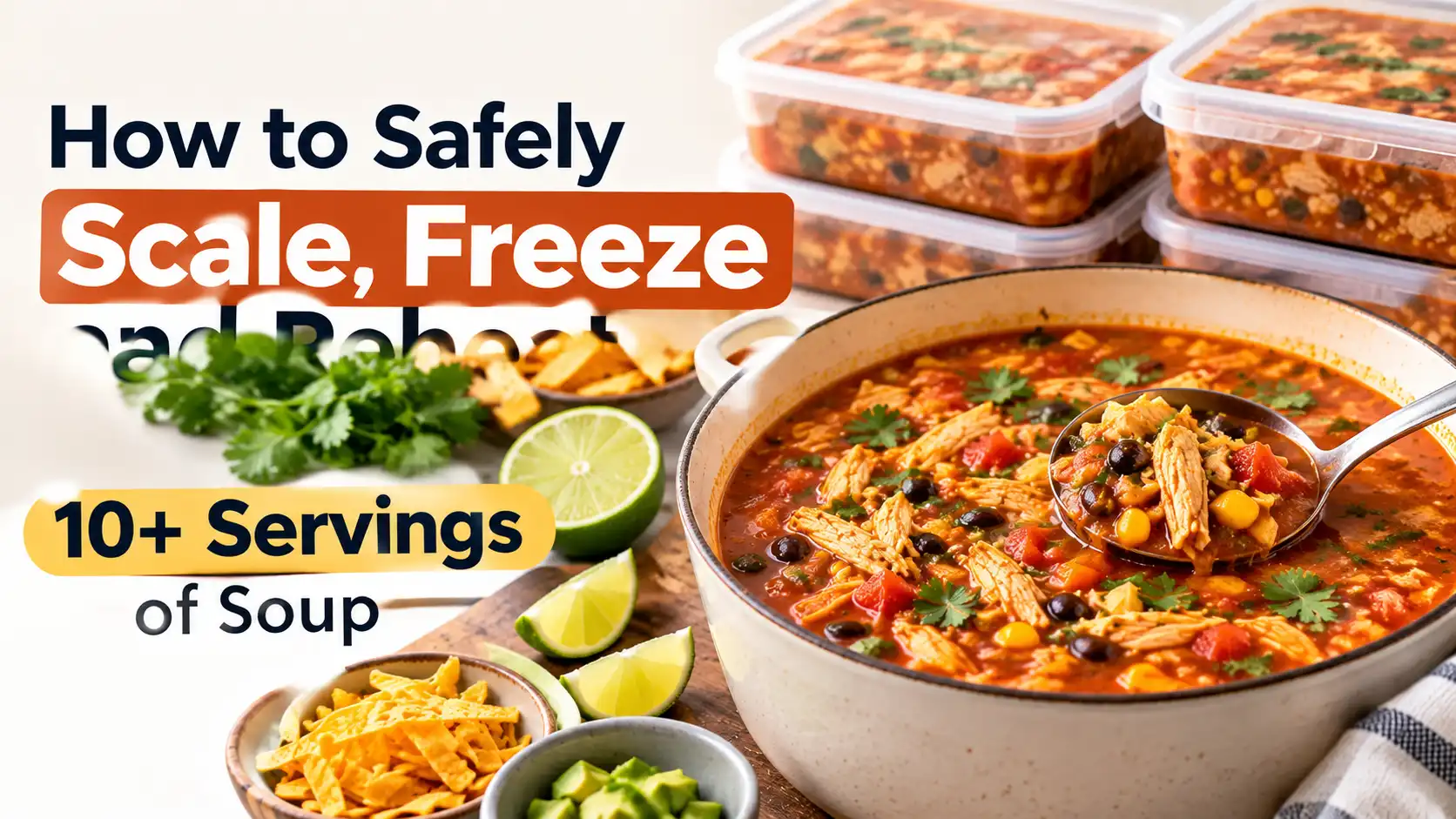
Table of Contents
Why Large Batches of Soup Are Different (and Riskier)
A single pot of soup for four people cools down fast. A five-gallon pot of soup does not.
According to the USDA, it would take an 8-inch stock pot of steaming chicken soup a long time to cool to a safe temperature in your refrigerator. If you put a giant pot of hot soup straight into the fridge, the outside gets cold while the inside stays warm for hours. That warm center is a breeding ground for bacteria.
The same rule applies to freezing. Hot soup in the freezer raises the temperature of everything around it and creates ice crystals that make your soup watery when thawed.
Large batches need special handling. You cannot treat a 5-gallon pot the same way you treat a 4-serving recipe.
How to Scale a Soup Recipe Safely for 10+ Servings
If you’re starting from a smaller recipe and scaling up to 10+ servings, you need to know that not all ingredients scale the same way.
The Scaling Factor Formula
First, calculate your scaling factor:
New Servings ÷ Original Servings = Scaling Factor
For example: 12 servings ÷ 4 servings = 3. That’s your scaling factor.
Ingredients That Scale Linearly
These ingredients can be multiplied directly by your scaling factor:
- Chicken
- Onions, carrots, celery, and other base vegetables
- Beans
- Corn
- Broth or stock
- Tomatoes
If your recipe calls for 1 pound of chicken and you’re scaling 3x, use 3 pounds.
Ingredients That Do Not Scale Linearly
This is where most people mess up. Spices, salt, and potent aromatics do not scale in a straight line. Their perceived intensity grows faster than the volume of soup.
The rule of thumb for doubling a recipe:
- Salt: Scale to about 75 to 80 percent of the linear amount
- Strong spices (cumin, chili powder, cayenne): Scale to about 50 to 75 percent of the linear amount, then taste and adjust
- Garlic and pungent aromatics: Scale to about 50 to 75 percent of the linear amount
Example: If your original recipe calls for 1 teaspoon of cumin and you’re scaling 4x, do not add 4 teaspoons. Start with 2 to 3 teaspoons, simmer, taste, and add more if needed.
Why this matters: Spices and salt concentrate as they simmer. A soup that tastes perfect when you add the spices can become overwhelmingly salty or spicy after 30 minutes of cooking.
The Pot Size Rule for Large-Batch Soup
You cannot cook 10 gallons of soup in a 5-gallon pot. Make sure your pot is large enough to hold the soup with at least 2 inches of space at the top. This gives you room to stir without splashing and prevents boil-overs.
How to Scale Soup Toppings for a Crowd
If you’re making soup for a crowd, remember that toppings need to scale too. For 10 to 12 people, plan for:
- 1/2 cup tortilla strips per person (6 cups total)
- 1/4 cup shredded cheese per person (3 cups total)
- 1/2 avocado per person (6 avocados)
- 2 tablespoons crema or sour cream per person (1.5 cups total)
[DIY Chicken Tortilla Soup Topping Bar Guide for Crowds]
The Two-Stage Cooling Method: The Step Most People Skip
This is the most important part of the entire process. If you get this wrong, everything else falls apart.
Why You Cannot Put Hot Soup in the Fridge
A large pot of hot soup in the refrigerator will stay in the Danger Zone (40°F to 140°F) for too long. Bacteria multiply rapidly in this range. Your fridge will also work harder to cool the soup, which can raise the temperature of other food inside.
The Two-Stage Cooling Process for Large-Batch Soup
The USDA and FDA recommend a two-stage cooling method:
Stage 1: Cool from 135°F to 70°F within 2 hours
Stage 2: Cool from 70°F to 41°F or below within 4 more hours
Total cooling time: No more than 6 hours
How to Cool Large Batches of Soup Fast
Here are the most effective methods for speeding up cooling:
- Divide into shallow containers: Split the soup into several shallow containers that are no more than 2 inches deep. This increases the surface area and allows heat to escape faster.
- Use an ice bath: Place the pot of soup into a larger container or clean sink filled with ice water. Stir the soup frequently. The ice bath should reach the level of the soup in the pot.
- Use an ice wand or ice paddle: These are filled with water, frozen, and then used to stir the soup. They cool the soup from the inside out.
- Add ice directly to the soup: For liquid-based soups, you can add ice cubes directly to the pot. This cools the soup from within. Just account for the extra water in your recipe.
- Stir and uncover: Stir the soup occasionally to release heat. Leave it uncovered until it stops steaming.
- Use a combination: The fastest method is to use an ice bath and an ice wand and divide into shallow containers. Combine methods for the best results.
How to Know Your Soup Is Cooled Enough to Freeze
Use a food thermometer. Check the temperature in several places, not just the surface. The soup should be at 41°F or below before you transfer it to the freezer.
Start your timer when the soup drops below 135°F. That’s when the clock starts for the two-stage cooling process.
How to Freeze Large-Batch Chicken Tortilla Soup Without Freezer Burn
Once your soup is cooled to 41°F or below, you’re ready to freeze.
Choosing the Right Containers
Heavy-duty freezer bags are the best option for large batches. They freeze flat, stack easily, and take up less space than rigid containers.
Airtight freezer-safe containers work well too, especially for portioning out individual servings. Glass containers are great but can be fragile in the freezer.
Vacuum-sealed bags are excellent if you have a vacuum sealer. They remove all the air, which prevents freezer burn and keeps the soup tasting fresh longer.
How to Fill Freezer Bags
- Label the bag first. Write “Chicken Tortilla Soup” and the date on the bag before you fill it. This is easier than trying to write on a full, floppy bag.
- Place the bag in a tall measuring cup or bowl. Fold the edges over the rim to keep them clean.
- Ladle the cooled soup into the bag.
- Leave 1 inch of headspace. Soup expands as it freezes. If you fill the bag too full, it will burst or leak.
- Squeeze out as much air as possible. Air is the enemy of frozen food. It causes freezer burn and ice crystals.
- Seal the bag tightly.
The Flat-Freeze Method
This is the space-saving trick every batch cooker should know.
- Lay the filled bags flat on a baking sheet in a single layer.
- Place the baking sheet in the freezer.
- Once the bags are frozen solid (usually 4 to 6 hours), remove the baking sheet.
- Stack the flat “bricks” of soup vertically like books.
This method saves an incredible amount of freezer space and makes thawing much faster because the soup is thin and flat.
Portion Sizes
Think about how you’ll use the soup:
- Single servings: 1 to 2 cups per bag. Perfect for quick lunches.
- Family servings: 4 to 6 cups per bag. Good for dinner for 2 to 4 people.
- Party portions: 8 to 10 cups per bag. For when you’re feeding a crowd again.
Freeze in the portion sizes you’ll actually use. Thawing 5 quarts of soup when you only need one bowl is wasteful.
What to Freeze and What to Keep Fresh
This is the single most important rule for freezing chicken tortilla soup:
Freeze the soup base. Never freeze the toppings.
Do Not Freeze These Toppings
- Tortilla strips: They turn soggy and mushy when thawed.
- Avocado: It browns and becomes unappetizing.
- Sour cream or crema: Dairy separates when frozen and thawed, resulting in a grainy, watery texture.
- Fresh cilantro: It wilts and loses its bright flavor.
- Shredded cheese: It becomes crumbly and dry.
- Lime wedges: They lose their juice and texture.
What You Can Freeze
- The soup base (broth, chicken, beans, corn, vegetables)
- Shredded chicken (if you want to freeze it separately)
- The broth (if you want to freeze it separately from the solids)
Pro tip: Some cooks freeze the broth and the solids separately. This lets you thaw only what you need and gives you more control over the texture when reheating. It’s not required, but it’s a nice option if you have the freezer space.
When to Add Toppings
Add all fresh toppings after the soup is reheated and in the bowl. Set up a small topping bar next to the stove, just like you would for a party.
[Link to our DIY Chicken Tortilla Soup Topping Bar Guide for Crowds]
How Long Can You Freeze Chicken Tortilla Soup?
The answer depends on who you ask, but here’s the range:
| Source | Recommended Freezer Time |
|---|---|
| Fareway | Up to 2 months |
| KitchenAid | Up to 3 months |
| What’s Gaby Cooking | Up to 4-5 months |
| Food Fanatic | Up to 6 months |
| USDA (safety) | Indefinitely safe, but quality declines |
For the best flavor and texture, use your frozen soup within 2 to 3 months. It will still be safe after that, but the quality will start to decline. The chicken may become stringy, the vegetables may get mushy, and the broth may lose some of its brightness.
How to Thaw Frozen Soup Safely
There are three safe ways to thaw frozen soup. The best method depends on how much time you have.
Method 1: Refrigerator Thawing
This is the safest and most hands-off method.
- Transfer the frozen soup bag or container to the refrigerator.
- Let it thaw overnight or for 24 to 36 hours depending on the size.
- The soup stays at or below 40°F throughout the thawing process, which keeps it out of the Danger Zone.
Move the soup from the freezer to the fridge the night before you want to eat it. If you’re thawing a large batch, give it a full 24 hours.
Method 2: Cold Water Thawing (Faster)
If you forgot to thaw the soup overnight:
- Keep the soup in its sealed bag or container.
- Submerge it in cold water. Never use warm or hot water — it can promote bacterial growth on the outside of the food while the inside is still frozen.
- Change the water every 30 minutes.
- The soup is thawed when it’s pliable and no longer has ice crystals.
Timing: A flat-frozen bag of soup thaws in about 1 to 2 hours using this method.
Method 3: Microwave Thawing (Fastest)
If you’re in a hurry:
- Transfer the soup to a microwave-safe container.
- Use the defrost setting or 50% power.
- Stir every 2 minutes to ensure even thawing.
- Cook immediately after thawing. Do not refreeze.
Microwave thawing can be uneven. The edges may start to cook while the center is still frozen. Stir frequently and check the temperature in several places.
Can You Reheat from Frozen?
Yes, but it’s not recommended. Reheating from frozen takes longer and can lead to uneven heating. The outside of the soup may boil while the inside is still icy. If you must reheat from frozen, use the stovetop on low heat and stir frequently, breaking up the block as it melts.
How to Reheat Large-Batch Soup to 165°F
Once your soup is thawed (or if you’re reheating leftovers from the fridge), here’s how to get it back to serving temperature safely.
The Golden Rule: 165°F
Reheat all soups to an internal temperature of at least 165°F. Bring soups and gravies to a boil.
Use a food thermometer to check the temperature in several places. The soup should be steaming hot throughout, not just warm.
Stovetop Reheating (Best for Large Batches)
This is the best method for reheating a big pot of soup.
- Pour the thawed soup into a large pot.
- Heat over medium-low heat, stirring occasionally.
- Bring to a gentle boil.
- Simmer for 5 to 10 minutes, stirring to ensure even heating.
- Check the temperature with a thermometer. It should read 165°F or above.
Why medium-low? High heat can cause the soup to stick to the bottom of the pot and burn. It can also cause dairy-based soups to separate. Low and slow is the way to go.
If the soup is too thick: Add a splash of chicken broth or water to thin it out. The soup thickens as it cools and freezes, so you may need to adjust the consistency.
Slow Cooker Reheating (Hands-Off)
A slow cooker is convenient, but it’s not recommended for reheating by the USDA. Slow cookers heat food too slowly and may keep it in the Danger Zone for too long.
If you want to use a slow cooker:
- Thaw the soup completely in the refrigerator first. Never put frozen soup in a slow cooker.
- Heat the soup on the stovetop to 165°F first.
- Transfer the hot soup to the slow cooker and set it to Warm (140°F or above) to hold it for serving.
This gives you the convenience of a slow cooker without the food safety risk.
Microwave Reheating (Individual Servings)
For single servings:
- Transfer the soup to a microwave-safe bowl.
- Cover with a microwave-safe lid or paper towel to prevent splattering.
- Heat on high in 2-minute increments, stirring between each.
- Check the temperature. It should reach 165°F.
Note: Microwave heating can be uneven. Stir well and check the temperature in multiple spots.
Oven Reheating (Large Batches)
If you’re reheating a large quantity and don’t want to use the stovetop:
- Preheat the oven to 325°F (no lower).
- Pour the soup into an oven-safe pot or casserole dish.
- Cover tightly with a lid or foil.
- Heat for 30 to 45 minutes, stirring once or twice, until the soup reaches 165°F.
This method works well but takes longer than the stovetop.
Food Safety Rules for Freezing and Reheating Soup
These rules are not suggestions. They are the difference between a delicious meal and a trip to the emergency room.
The Danger Zone
Bacteria multiply rapidly between 40°F and 140°F. Keep hot food at 140°F or above and cold food at 40°F or below.
The Two-Hour Rule
Never leave perishable food at room temperature for more than 2 hours. If the temperature is above 90°F (like at a summer picnic), that window drops to 1 hour.
This applies to the soup and the toppings. Cheese, sour cream, avocado, and cut vegetables are all perishable.
Reheating Temperature
Reheat all soups to 165°F. Use a thermometer. “Steaming hot” is not a measurement.
Cooling Temperature
Cool soup from 135°F to 70°F within 2 hours, then to 41°F within 4 more hours.
Do Not Reheat Multiple Times
Reheating the entire batch multiple times introduces cumulative risk and degrades quality. Reheat only what you plan to eat. If you have a large batch, portion it out and reheat individual servings.
When in Doubt, Throw It Out
If you’re not sure how long the soup has been sitting out, or if it smells or looks off, throw it away. Food poisoning is not worth the risk.
Common Questions
Can I freeze chicken tortilla soup with the toppings already in it?
No. Freeze the soup base only. Tortilla strips get soggy, avocado browns, and dairy separates. Add all toppings fresh after reheating.
How long does chicken tortilla soup last in the freezer?
For best quality, use within 2 to 3 months. It’s safe indefinitely, but the texture and flavor will decline over time.
What’s the best container for freezing soup?
Heavy-duty freezer bags are best for large batches because they freeze flat and stack easily. Airtight containers work too.
How much headspace should I leave?
Leave 1 inch of headspace at the top of the container or bag. Soup expands as it freezes and needs room to grow.
Can I put hot soup in the freezer?
No. Hot soup raises the freezer temperature, creates ice crystals, and can compromise the safety of other food in the freezer. Cool it completely first.
How do I cool a large pot of soup quickly?
Use an ice bath, an ice wand, or divide the soup into shallow containers. Combine methods for the fastest results.
How do I reheat frozen soup?
How do I reheat frozen soup?
Thaw overnight in the refrigerator, then reheat on the stovetop over medium-low heat until it reaches 165°F. Bring it to a boil for soups and gravies.
Can I reheat soup in a slow cooker?
The USDA does not recommend reheating in a slow cooker because it heats too slowly. Heat the soup to 165°F on the stovetop first, then transfer it to a slow cooker on Warm to hold it.
Why does my reheated soup taste different?
Freezing can dull spices and change the texture of vegetables and chicken. Add a squeeze of fresh lime, a pinch of fresh cilantro, or a splash of broth when reheating to wake up the flavors.
Can I add masa harina after freezing?
Masa harina thickens soup as it cools, so frozen soup may be thicker than you remember. Add a splash of broth when reheating, and if you want it thicker, make a fresh slurry and stir it in.
Freezing and reheating large batches of chicken tortilla soup is not complicated, but it does require attention to a few key details.
The three rules to remember:
- Cool it fast. Two-stage cooling: 135°F to 70°F in 2 hours, then to 41°F in 4 more hours.
- Freeze it flat. Bags, 1 inch of headspace, laid flat on a baking sheet.
- Reheat to 165°F. Bring it to a boil. Use a thermometer.
Do those three things, and your future self will thank you. You’ll have a freezer full of soup that tastes almost as good as the day you made it — ready to go on a night when you don’t have the energy to cook.